
Marengo | Value and History of the Gold Marengo
Updated:
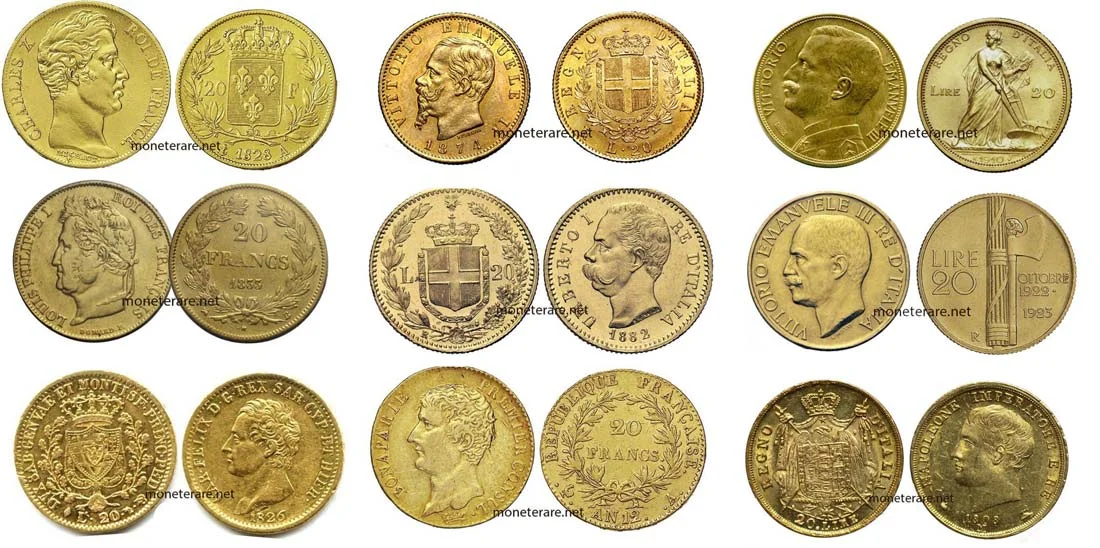
Marengo is a term used in the field of Numismatics to refer to gold coins minted since 1801 with a value of 20 Francs or 20 Lire.
The coin was named after the Piedmontese battle that took place at Marengo against the Austrians on June 14, 1800, a battle won by Napoleon. Therefore, the history of the Marengo is also part of Italy's history, and not just that.
There is often talk of the French Marengo, the Italian Marengo, and the Swiss Marengo. Let’s now look at some of these coins to understand their numismatic and historical value.
The Gold Marengo
The Marengo, also known as “Napoleon” for obvious historical reasons and “Gold Marengo” in reference to the material it was minted from, is a coin made of gold with a value corresponding to 20 francs.
Right in Turin, occupied by the French, the Subalpine Republic was established, which produced a series of significant and important monetizations.
In fact, the decimal system (which had been introduced in France in 1795) was adopted, and the first gold coin with a decimal system ever created in Europe was minted: the 20 francs.
The Marenghi did not cease to exist with the exile of Napoleon Bonaparte. The term, which had become familiar, came to indicate all 20 Franc gold coins produced on French soil throughout the entire 19th century.
With the establishment of the Latin Monetary Union, a sort of early European Union, the use of the term Marengo became so prominent that it involved the member states of the newly formed coalition. Some of these included France, Spain, Belgium, Switzerland, Greece, Venezuela, and Italy.
Characteristics of the Gold Marengo
- Diameter: 21.5 mm
- Weight: 6.45 g
- Material: Gold 900
20 Francs Gold: The French Marengo
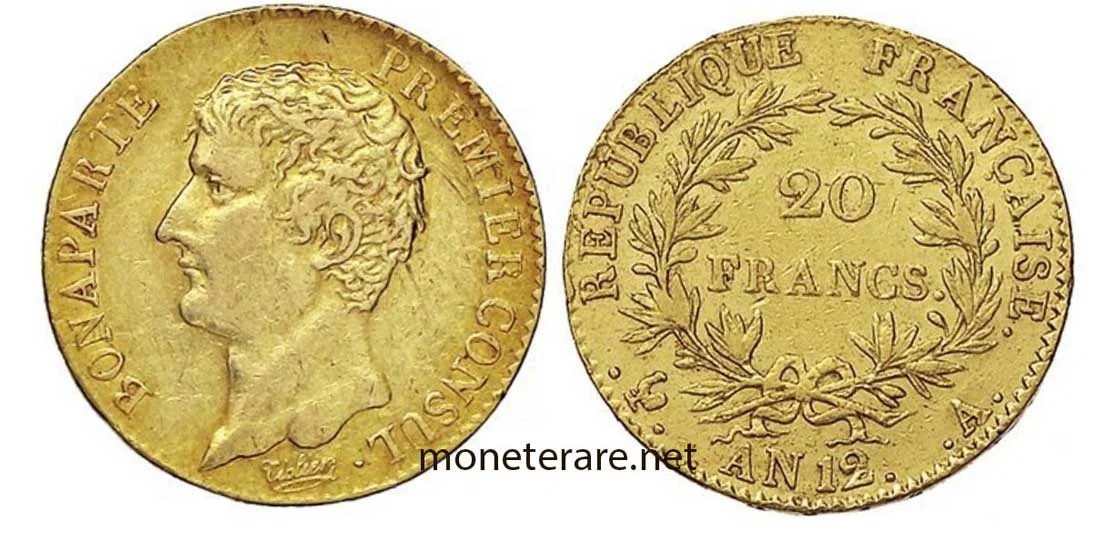
The first coin of this type to be minted was the 20 francs gold coin struck at the Turin mint. After it, all coins with the same weight, diameter, and material were named “marenghi.” France, eager to celebrate Bonaparte's victory, was, as mentioned, the first to mint a coin of this type.
Subsequently, it was the only one to mint a variety of marengo so extensive that it produced several variants. This happened due to the rapid alternation of Emperors and republican transitions, which, from time to time, wanted to express their own vision by changing this or that detail of the historic coin.
The marenghi of the first period are particularly sought after today due to their historical value, more than economic. Indeed, for many, it is not common to witness, through an object of ownership, the transition from consul to emperor of Napoleon. The same goes for the transition from the French revolutionary calendar to the Gregorian calendar that began in 1806.
The marenghi of this period depict on the obverse the profile of Napoleon along with the inscription of Napoleon consul or emperor.
20 Francs Gold: Marengo Napoleon Consul
The 20 francs gold coin representing Napoleon consul featured, on the obverse, the profile of the young man facing left surrounded by the phrase “Bonaparte Premier Consul” and the engraver's signature TIOLIER under the neck.
On the reverse, however, two branches of oak and olive tied were engraved, at the center of which was the value of 20 Francs written on two lines. Outside the branches were the inscriptions “Republique Francaise”, Year 12, the A indicating Paris, and the French symbol of the Rooster included between two dots.
Marengo Napoleon Emperor
The coin representing Napoleon Emperor, on the other hand, featured on the obverse the profile of Bonaparte facing left and the inscription Napoleon Empereur around the edge, with the engraver's signature TIOLIER under the neck.
The reverse around the edge bore the inscription Republique Francaise, the year AN 12. The mint mark A of Paris and also in this case the Rooster included between two dots and outside the tied olive branches below. In the center, clearly readable, was the value of 20 FRANCS engraved on two lines.

Marengo Louis XVIII
Between 1814 and 1816, a new type of Marengo was minted, featuring the portrait of a new ruler: Louis XVIII.
The 20 francs gold coin in question features on the obverse the profile of the king facing right, surrounded by the inscription “Louis XVIII Roi de France.” and under the neck, the signature of the author MICHAUT F. On the reverse, however, there is the crowned coat of arms between olive branches, included between the engraving of the value “20 F” and accompanied by the year of production.
From 1816 to 1824, King Louis XVIII returned from his London exile and minted a new Gold Marengo, the third in order of production.

This coin was produced in 8 different mints whose marks are:
- A for Paris
- L for Bayonne
- Q for Perpignan
- W for Lille
- K for Bordeaux
- T for Nantes
- H for La Rochelle
- MA for Marseille.
Marengo Charles X
Upon his death in 1824, the throne was inherited by Charles X. The 20 francs gold coin produced in his favor featured on the obverse the profile facing right of the new King, the name on the left side and the title on the right side.

Below the face was the engraver's signature MICHAUT. The reverse, however, featured the crowned coat of arms included between olive branches and at the bottom the date included between the design and the mint symbol. Charles X minted his gold marengo from 1824 until 1830, in four different mints: Paris, Lille, Nantes, and Perpignan, for a total of 1,563,830 pieces.
Marengo Louis-Philippe I

In July 1830, Charles X fled to England and France elected King Louis-Philippe I, Duke of Orleans. The country, in addition to being characterized by a strong and new capitalistic and industrial vein, witnessed the spread of two new types of gold coins during the eighteen years of Louis-Philippe I's reign. The first type was minted between 1830/1831.
In 1830, as many as 18,391 specimens were minted at the Paris mint, while very few coins were minted abroad. The latter can be recognized by the mint mark above, namely H. In 1831, however, the marenghi were minted in 4 mints, namely Paris (A), Lille (W), Rouen (B), Nantes (T). Those made in Paris feature on the obverse the profile of the King, surrounded by the inscription “Louis Philippe I – Roi Des Francais” and below the portrait the engraver's signature Tiolier.
On the reverse, however, is engraved a crown made from an olive branch and a laurel branch, with the value and year indicated in the center.
The second type of Marengo was minted between 1832 and 1848 in 4 mints already used in the first version (therefore Paris, Lille, Rouen, and Nantes) plus the Bayonne mint. Again, on the obverse, the profile of the King is depicted, the inscription “Louis Philippe I – Roi Des Francais” and below the bust the signature DOMARD F. On the reverse, the crown of an olive branch along with a laurel branch is depicted, and in the center, the inscription with the value and year.
Starting from 1848, there will be a transition to the Second Republic.
Marengo Napoleon Emperor and King
This is a gold Marengo minted by the Milan mint between 1808 and 1814. On the obverse, the profile of Napoleon surrounded by the inscription “NAPOLEONE IMPERATORE E RE” and the symbol of the Milan mint. On the reverse, the inscription “REGNO D'ITALIA” the central coat of arms under the royal crown, with an eagle facing left like the KING, below the value of 20 Lire.
Value of Marengo Napoleon Emperor and King
A 20 Lire coin from 1813 R in BU was auctioned on December 4, 2012, for the sum of 15,340€.
Value of French Marengo
The value of French Marenghi is calculated based on its weight in gold, except for those rare coins that, in addition to the weight of gold, have a particularly high state of preservation and a rarity above average. That said, the value of a Marengo today can vary between 200/240€.
The Marengo of the Kingdom of Sardinia
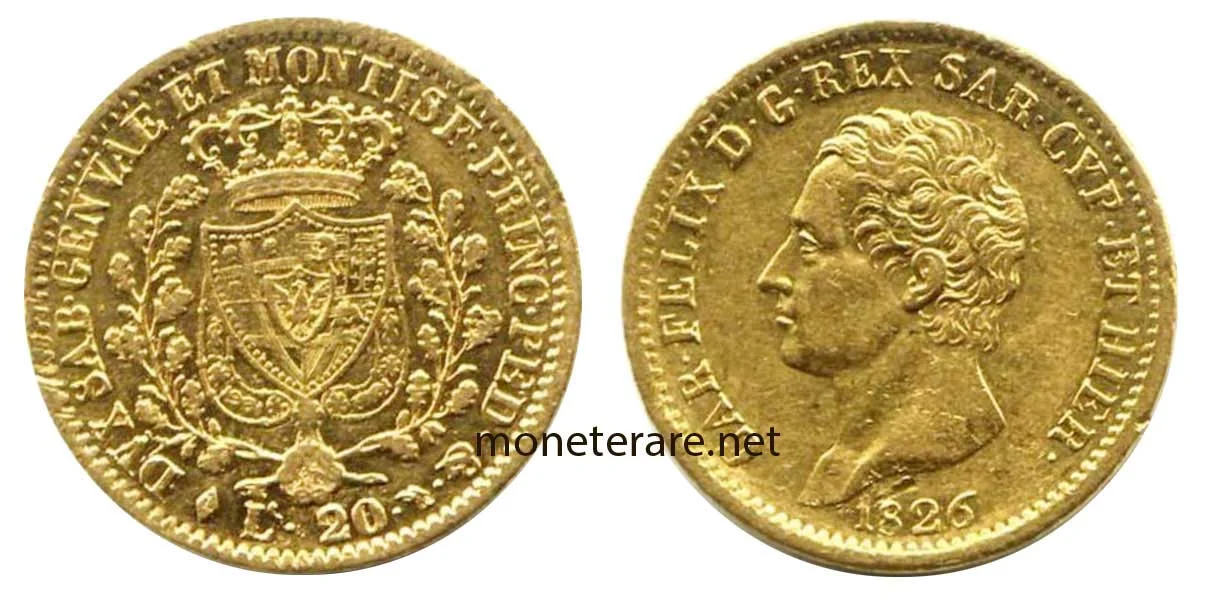
Now let's look at the differences between the gold marengo of Carlo Felice and the marengo of Carlo Alberto, both from the Kingdom of Sardinia.
Marengo Carlo Felice
This type of marengo was minted from 1821 to 1831 and many of these coins are considered rare.
On the Obverse, there is the profile of the King facing left, with the inscription “CAR FELIX D G REX SAR CYP ET HIER” running along the edge. Below the neck is the signature of the author Amedeo Lavy and the year of minting.
On the Reverse, the coat of arms of the House of Savoy is prominent, surrounded by oak branches and the Royal Crown, with the value of 20 Lire and the mint mark below. Along the edge, the inscription reads “DVX SAB GENVAE ET MONTISF PRINC PED &”.
- Weight: 6.45 g
- Diameter: 21 mm
- Mint: Genoa/Turin
- Material: 900 gold
- Axis: French style
Value of Marengo Carlo Felice
One of the 313 specimens of Marenghi Carlo Felice from 1825 R5, in a condition of MB+, was sold at auction on October 16, 2007, for the amount of €16,675
Marengo Carlo Alberto
From 1831 to 1841, the 20 lire coins dedicated to Carlo Alberto, King of Sardinia, were minted. On the Obverse, there is the profile of King Carlo Alberto facing left, with the inscription “CAR – ALBERTVS D – G – REX SARD – CYP – ET HIER” along the edge and the signature of the author Ferraris below the King's neck. In this case, these coins are often rare, but not as much as those from 1842 R4.
On the Reverse, the Savoy cross is depicted among laurel branches and the Royal Crown, with the inscription “DVX SAB – GENVAE ET MONTISF – PRINC – PED – &” along the edge. Below is the value in Lire and the mint symbol.
- Weight: 6.45 g
- Diameter: 21 mm
- Mint: Genoa/Turin
- Material: 900 gold
- Axis: French style
- Edge: Reeded
Value of Marengo Carlo Alberto
Just to mention an auction, on April 8, 2010, a specimen R2 of Marengo Carlo Alberto in FDC from 1838 was sold for €3,105
The Italian Marengo: the 20 Gold Lire
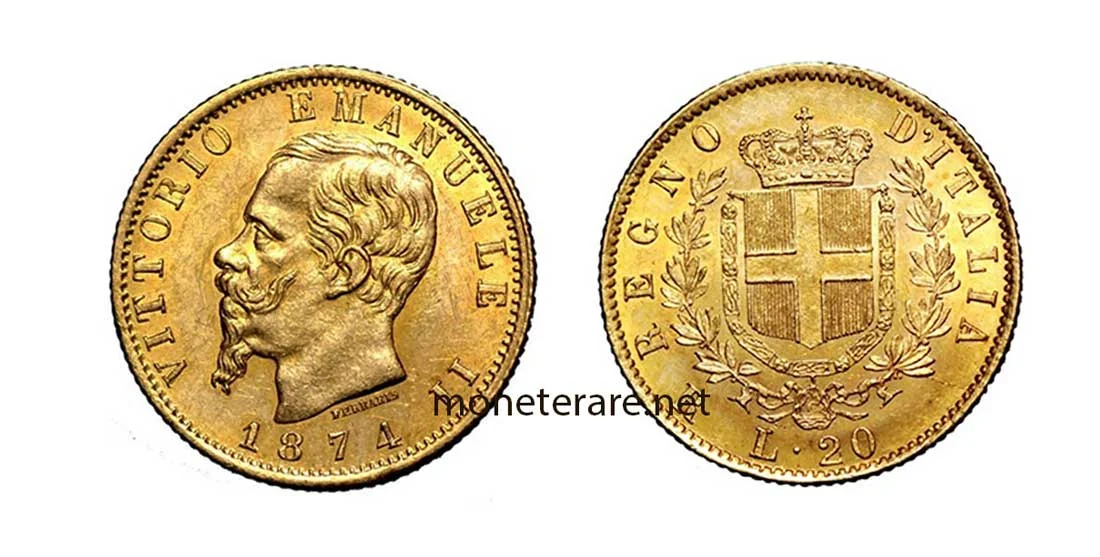
Between 1861 and 1923, the Kingdom of Italy also issued gold marengo coins. They were the famous 20 gold lire, all similar in weight (equal to 6.451 grams), metal used (gold 900), diameter (21 millimeters), and French axes.
Marengo Vittorio Emanuele II
The first 20 gold lire marengos to be circulated were those commissioned by Vittorio Emanuele II. It features on the Obverse the bust of the king facing left, surrounded by the inscription Vittorio Emanuele II. Below the bust is the name of the engraver FERRARIS. On the Reverse, the Savoy coat of arms surrounded by the collar of the Annunziata set among laurel branches, with the legend Regno D’Italia all around and at the bottom the value and mint mark.
20 Gold Lire: Marengo Umberto I
Starting from 1879, with the election of King Umberto I, son of Vittorio Emanuele II, other 20 gold lire marengos were produced, dedicated to the new sovereign.

The first Marengo dedicated to Umberto I on the Obverse featured the profile of the new King, with the inscription “Umberto I Re D’Italia” around the edge, below the neck the signature of the engraver: Speranza and at the bottom the date of distribution.
On the Reverse, one can see the Savoy coat of arms surrounded by the collar of the Annunziata included between an oak branch and a laurel branch, the engraving of the value, the mint mark, two five-pointed stars, and the date at the top center.

Marengo Vittorio Emanuele III Aquila
Following the 20 lire coin dedicated to Umberto I, came the Marengo dedicated to Vittorio Emanuele III.

It was 1902 and the coin depicted on the Obverse the face of the new King, with the engraving, all around the name and below the neck the signature of Speranza.
On the Reverse, this time, the heraldic eagle is present along with the coat of arms of the House of Savoy, with the inscription Regno D’Italia around the edge and separated by two Savoy knots, the mint mark, two five-pointed stars, and the date.
Marengo Aratrice
Following Royal Decree 258 of May 5, 1910, a new version of the coin was issued featuring the profile of the King in uniform. Inside a rectangle that serves as a frame, present at eight o'clock, a Savoy knot.

The Reverse is completely different from the previous one and represents a plowwoman indicating Italy, who holds the plow with her right hand and a bundle of ears of wheat with her left. At the top is the inscription Regno D’Italia, while the value is indicated on both sides: to the left of the figure the word Lire is engraved and to the right the number 20. In exergue are the names of the authors Luigi Giorgi and Egidio Boninsegna.
Marengo Fascio
There is also a third version of the Marengo dedicated to Vittorio Emanuele III, which presents on the obverse the same as the previous one except for the signature of the engraver MOTTI.

On the reverse, however, the fascio littorio is depicted with the axe facing right adorned with a ram's head, to the left on two lines the value is engraved and to the right the legend (on two lines) OTTOBRE 1922 • 1923. To the left is the mint mark. This is a commemorative coin made by Attilio Silvio Motti and minted on the occasion of the first anniversary of the march on Rome along with the 100 lire Fascio. This Marengo never circulated due to high inflation.
Value of the Italian Marengo
As with the French one, to calculate the value of the Italian Marengo it is essential to refer to the variability of the gold price. Excluding historically rare and valuable Marengos such as some of Vittorio Emanuele II, especially the one from 1873, or Umberto I in red gold, one of the rarest, for example, is from 1882.
Basically, the value of Marengos ranges between 200/240 € but selling it at numismatic auctions can easily yield a profit of up to 30% more.
Didn't find what you were looking for? Check out these topics:
- To learn all about the Gold Pound, click here.
- If you are looking for Rare Euro Coins then click here.
- If you want to invest in gold, coins, or bars read here: buy gold.
- Rare Lire and their great value have been discussed here.
- We have talked about the Value of Phone Tokens on this page.
- To Sell or Buy Rare Coins online, read these tips.
- All information on 500 silver lire can be found here.
Frequently asked questions
What is the value of a gold marengo?
The value mainly follows the price of gold (weight ~6.45 g) plus a numismatic premium for year, mint, and condition. Always compare with the spot price of the day.
Where to Sell or Buy Coins
Do you own coins like these (or maybe lots or rare unique pieces)? Turn your passion into profit with online auctions! Have fun selling your treasures or find great deals to grow your collection. For years we have trusted this auction portal, our trusted partner – the world's largest coin auction site. Click here to register for free and browse the auctions: it's simple, exciting and more rewarding than you might imagine!